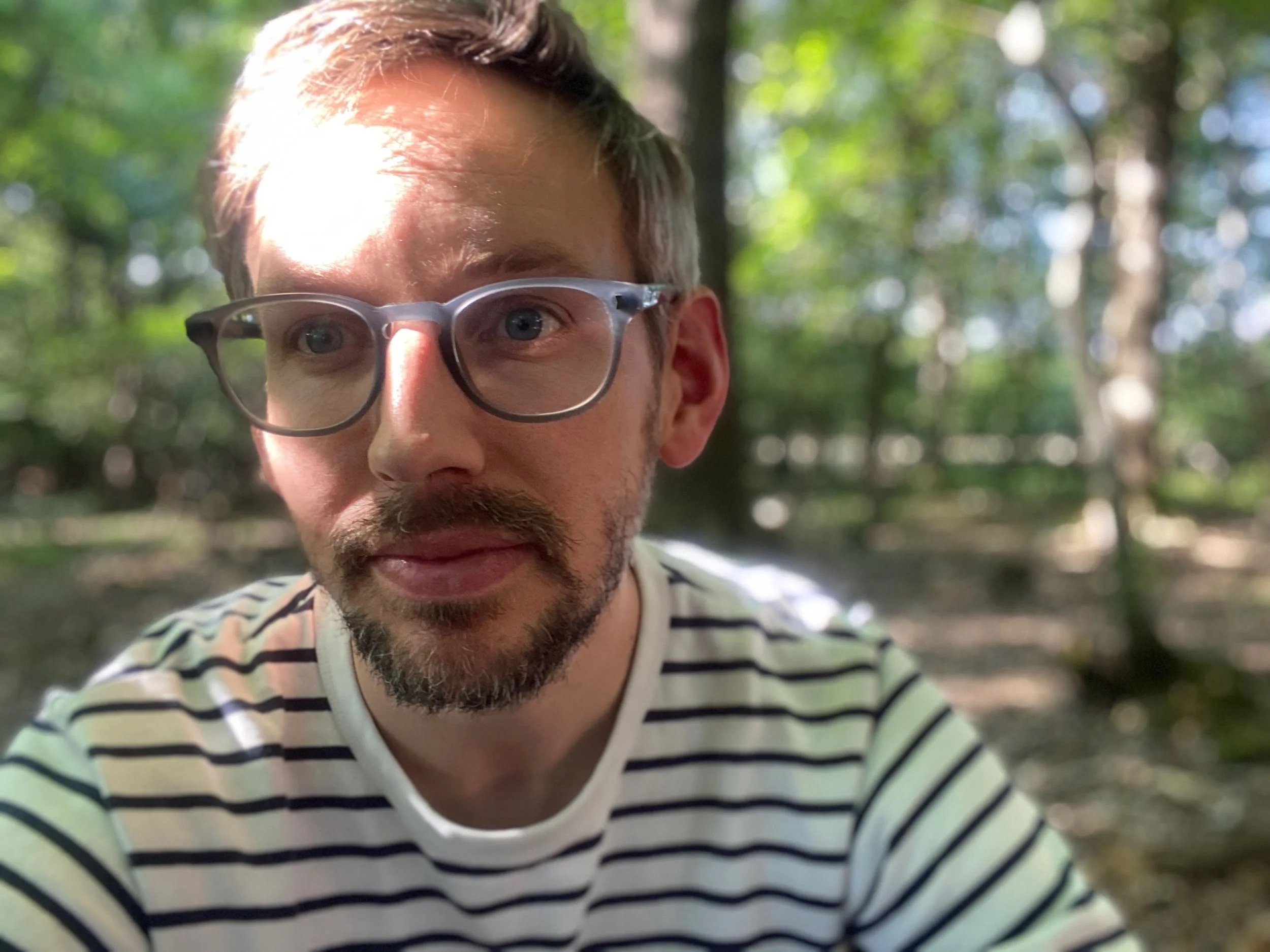
Christopher Oldfield
My professional life
I am an interdisciplinary philosopher specialising in metaphysics. I have held a range of teaching and research positions, e.g. at The Faraday Institute for Science Religion and the Faculty of Philosophy in the University of Cambridge, Fordham University, the University of Hertfordshire, King’s College London, St Mellitus College, the University of Oxford, and University College London. I also offer bespoke courses of 1:1 tuition and guidance on a wide range of subjects.

“Philosophy has many tasks, yet in our age the task of bracketing and seeing, of uncovering our forgotten sense of the cosmos, and of our lives therein, may be one of the most urgent."
— Erazim Kohák (1984) The Embers and the Stars: A Philosophical Inquiry into the Moral Sense of Nature, p.26; chapter 1: Theoria

My philosophical research addresses foundational questions in the logic and practice of scientific metaphysics. I have special interests in the history and interpretation(s) of “naturalism” and “physicalism” in the philosophy of mind.
I’m interested in the metaphysics of the manifest image, in ways of attending to things unseen in the scientific image, and the potential use of organicist principles to reconcile a constructive empiricist philosophy of the object of mathematical physics with a realist philosophy of the objects of perception.
Interests

“Vouloir faire tenir la nature dans la science, ce serait faire entrer le tout dans la partie”
— Henri Poincaré, Science et Méthode (1920, p.8; §1 Le Choix des Faits)
Motivations
I aspire to be a philosopher, a lover of wisdom and understanding. I once heard Brian Leftow say the love of wisdom can take the forms of desire and delight. I desire to understand much that I do not, and delight to understand what little I can (or at least to find the least stupid thing we can say about a given subject).
I also grieve the poverty of public discourse at present, especially what passes for an understanding of the virtues (or the vices) of science and religion in our time. I aspire to promote a more literate experience, to remedy the wealth of myth-understandings at work, inside and outside the philosophy room

“…they suppose themselves to be above ‘metaphysics’ when in fact they are only a very little above it - being up to the neck in it.”
— Joseph Henry Woodger, Biological Principles (1929, p.246; II.V; §4)
I learned from James Ladyman, Bas van Fraassen, and Hans Halvorson to think of naturalism and empiricism as ways of asking ontological questions, not to be confused with an answer, or the only way of asking them. I learned from Peter Harrison, Alasdair MacIntyre and Maria Rosa Antognazza of the deep benefit to philosophy of the study of its history. I learned from Michael Friedman and Thomas Uebel that the physicalist manifesto of the Vienna Circle has been radically misunderstood; and from Janet Soskice, Peter van Inwagen and Merold Westphal how to think through confessions of faith, bewilderment and suspicion. I learned from Matthew Soteriou how much flows from the adoption of a temporal perspective, and how revisionary projects in metaphysics, well motivated in the service of descriptive projects, can quickly become unhinged.
Inspirations
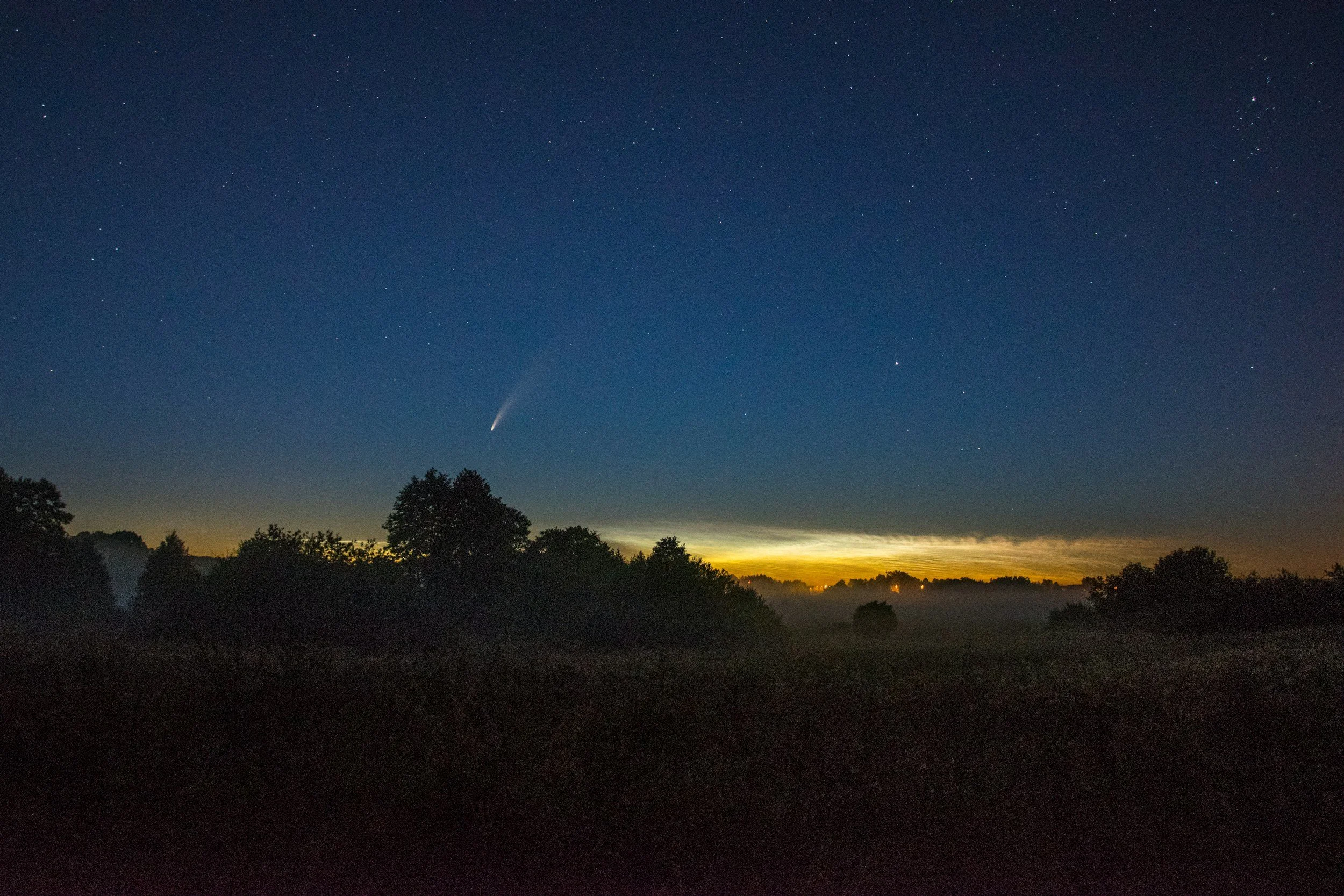
Stock photograph of some magnificent Noctilucent Clouds. I once beheld something similar in the midnight sky on the Suffolk coast. Brighter than Venus it was. The evening was calm, the air so still, but for the smoke of the fire. We sat there, bewildered, between the embers and the stars.
“Better real confusion than false clarity; better real darkness than misleading light.”
— Fr. Thomas Hopko
Portfolio

2022 Workshop on Nature’s Goals, Hylomorphism and Teleology at Corpus Christi College in the University of Cambridge. Photograph courtesy of the organisers.
-
Lecturer (Selected)
University of Hertfordshire
Metaphysics 2024-25University College London
Science and Religion
- New Atheism 2023-25
- Darwinism 2024-25St Mellitus College
- New Atheism 2021-25University of Oxford
The Limits of Philosophy, Science and Religion (with Stephen Law, 2022)Fordham University
Philosophical Ethics, 2016-19
Tutor (Cambridge)
Faculty of Philosophy
- Ethics and Political Philosophy
- Knowledge, Language and World
- Metaphysics
- Philosophy of Mind
- Philosophy of ScienceSCIO Seminar Programme
- The Lewis-Anscombe DebateThe Faraday Institute
- Polkinghorne’s Critical Realism
- Van Fraassen’s Constructive Empiricism
- The Myth of “Classical Physics”
- Quantum Non-Locality and RelativityOther (Bespoke, 1:1 private tuition)
- Meta-Ethics (1)
- Meta-Ethics (2)
Teaching Assistant (London)
UCL
History of Modern Science
Philosophy of Science
Science and ReligionKCL
Philosophy of Physics
Metaphysics
Philosophy of Psychology
Philosophy of Religion
Philosophy of Mind
-
Publications
‘Myth-Understanding Scientific Agency: the Tragedy of Scientism in a Secular Age’ (2026) forthcoming in Issues in Science and Theology 9: Constructions of Narrative in Science and Religion, edited by Louise Hickman, Michael Fuller, Mark Harris and Joanna Leidenberg. ,Why Middle Sized Matters to Science and Religion (2025), William Simpson and I co-edited this special issue of Scientia et Fides, Vol. 13, No. 2 (October 2025). Our editorial, with seminal contributions from Barbara Drossel, George Ellis, Hans Halvorson, Robert Koons, Emily Qureshi-Hurst, and Howard Robinson, among others, is available online.
Projects
Attention as Spiritual Practice
(Full Proposal, currently unfunded)
Jonathan Jong, Mari van Emmerik, Pui Him Ip and I formed plans for an interdisciplinary research project, to be hosted by the Faculty of Divinity in the University Cambridge.
The Activity View
(Research Project hosted at the Faraday Institute for Science and Religion, 2021-24 generously funded by the Fetzer Institute)
Following Bas van Fraassen’s (2002) rejection of the meta-philosophical ‘principle zero’, that for each philosophical position X there exists a statement X+ such that to adopt position X is to believe accept that thesis X+’, I am working to develop an alternative way of thinking about what is at stake in debates about a range of philosophical ``-isms” (like “naturalism”, “physicalism”, “scientism”, etc).
TL/DR: The Activity View promises to explain why arguments for/against specific theses often serve to generate more heat than light, by identifying a profound but persistent meta-philosophical error. The error is to mistake the spirit of an activity for the content of a theory. I develop the motivation for The Activity View in my paper, ‘Naturalism without Content: Where Planting’s Conflict Actually Lies’, and explore its potential to make sense of current debates in ‘The Activity View of Physicalism’.
The Logic of The Special Composition Question(s).
(Doctoral Research Project at King’s College London; completed in 2021, revised and resubmitted 2023 under the supervision of Matthew Soteriou and Bill Brewer)
TL/DR: The logic of the special composition question(s) has been lost in translation into higher order and singular terms a modal restriction Ψ(S) in virtue of which ‘a class, S has a fusion’. In his (2021) examiner’s report, Eric Olson praised my attention to detail, calling it ‘a great service’ to the field. What was evidently less clear to my examiners was the philosophical significance of this discovery.
The Metaphysics of Lives
Lives matter. Lives count. Life matters, in van Inwagen’s (1990) organicist metaphysics, but it is not easy to say what counts as a life, inside or outside the ontology room, in the science of life, or in the life sciences. If we hope to distinguish the tree of life from the life of a tree, then we are confronted by a puzzle.
The puzzle, which I explored five ways to resolve toward the end of my original (2021) thesis, was to reconcile van Inwagen’s (1990) provisional explanations, according to which `a life is a special kind of self-maintaining event’ etc with a bewildering implication of van Inwagen’s (2014) favored ontology, which ontology ‘implies that there are no events.’
All this work was cut from the revised (2023) version of my (2021) thesis, ‘The Logic of the Special Composition Question(s)’, for which after a year of waiting for the UCU marking boycott to resolve, and another 18 month appeal process, I eventually received an MPhil. My supervisors and I suspect that this might be one reason why my examiners expressed their regrets in 2024 for saying ‘this thesis clearly satisfies the criteria’ required to award the PhD, having decided to indicate on the decision form that it had not done so. Joanna Leidenhag suggested that I turn my work into a proposal to write another thesis in Divinity, (‘A Life Inside the Ontology Room’) but alas my proposal was ‘too philosophical’ for the Faculty of Divinity in Cambridge at the time.
-
Metaphysics
The Manifest Invalidity of the Kalam Kalam Cosmological Argument (Draft)
Bound States and Living Organisms
(Draft, Audio from Bristol 2023)Pan-Psyche-Ism
(Draft, Audio from Helsinki 2025)When Are Fosters Parts?
(Draft, Video from King’s 2024)The Activity View of Physicalism
(Draft, Abstract from Cambridge 2024)Hylomorphism and the Inverse Special Composition Question (Draft, Video 2023)
Issues in Science and Theology
“Modern Science Yes, Western Science No!” Needham’s World and the May 4th Movement (Draft from ESSAT 2026)
Myth-understanding Scientific Agency:
the Tragedy of Scientism in a Secular Age
(Draft, from ESSAT 2024)Naturalism without Content:
Where Plantinga’s Conflict Actually Lies
(Draft, Video from Krakow 2024)An Essay in Aid of a Grammar of Doubt
(Draft, Audio from Sydney 2026)Newman, Plantinga and Darwin’s Doubt (Draft, Slides from Warwick 2025)
Thinking with Assent,Living with Doubts: Questions as Modes of Holding Propositions (Handout from Newman House UCD 2024)
-
-
2026 God, the Brain and the Nature of Truth: reply to Iain McGilchrist’s Boyle Lecture, International Society for Science and Religion
2026 Christian Humanism and the Imago-Dei; Understory Festival, Washington DC
2025 Communal Living as Spiritual Practice: in conversation with Elizabeth Oldfield for John Vervaeke’s Lectern Dialogue Series
2025 Discussion on Physicalism,
with Nathan Hawkins (unedited version)2024 On Praise of Love an Being in Love as an Ethical Idea (video, slides); St Ethelberger’s Centre for Peace and Reconciliation, London
2024 The Metaphysics of Pregnancy: dispatches from the B.U.M.P. debates (Podcast, Slides), Program for Medicine, Spirituality and Religion, Yale University
2023 Extended Q+A with Iain McGilchrist on The Matter with Things with reading group at the Faraday Institute for Science and Religion
2023 `Can A Rational Person Believe in Miracles?' (1 minute apologetic in response to a prompt from the UCCF ‘Science Network’)
2022 The Selfish Green? panel discussing the religious roots of the Anthropocene (with Mazviita Chirimuuta, Timothy Howles, Hannah Malcolm), Greenbelt Festival
2022 The Limits of Philosophy, Science and Religion (with Stephen Law), Department of Continuing Education, University of Oxford
2021 Epiphany (article)
Christchurch London Broadcast2017/2019 The Myth of Conflict (article) Christchurch London Broadcast
2017 Science, Religion and the Ethics of Belief, (Evening Lecture) for the Institute of Physics: Northern Branch, University of Leeds
2017 Science, Religion and the Business of Knowledge (keynote) for Faraday course, Department of Physics, University of Hull
2016 Who’s Afraid of Naturalism? (article) for Pulse magazine 22 (Spring 2016):
-
Memberships
European Society for Science and Theology (2024- present)
British Society for the History of Philosophy (2023-present)
International Society for Science and Religion (2023-present)
British Society for the Philosophy of Science (2022-present)
Postdoctoral Society of Trinity College, Cambridge (2022-2024)
Employment
Teaching Assistant, Department for Science and Technology Studies, University College London (2023-)
Research Associate, The Faraday Institute for Science and Religion, Cambridge (2021-)
Adjunct Professor, London Faculty for Teaching, Fordham University (2016-2019)
Testimonials

2024 presentation on Thinking with Assent while Living with Doubts at Newman House, University College Dublin Photograph courtesy of the organisers of Wittgenstein, Newman and Hinge Epistemology
“I am indebted to Christopher Oldfield of the Faraday Institute at the University of Cambridge for his illuminating grasp of the scientific, philosophical, and theological dimensions of reductionism.”
— Jeremy Begbie, Duke Divinity School and the University of Cambridge
“Rigorous, clearly explained technical concepts, always available and responsive to questions.”
“He’s great, absolutely wonderful. I think I want to take this subject for a Masters”
“Helpful, informative seminars, Chris went out of his way to help me when I was struggling”
— Anonymous KCL Staff and Student teaching evaluations (avg 4.6/5.0)
“I wanted to thank you for your time and instruction. Science and Religion is in my top 3 favourite courses I have ever taken and gave me much to ponder after every class. I really enjoyed our conversations and how much attention you put into your lectures.”
“I just wanted to let you know […] how much I enjoyed our weekly seminars. You made the conversations so informative, digestible, and interesting! Truly made me more interested in the course, I looked forward to it every week.”
— Unsolicited UCL student emails from the 2024 HPS/BASC programme

“A confession of bewilderment is not a presentation of an argument for the thesis that anyone else should be bewildered by whatever it is that the speaker finds bewildering.”
— Peter van Inwagen [2011] 2014 Relational vs Constituent Ontologies; in Existence: Essays on Ontology, p.210
“The image is not a certain meaning, expressed by the director, but the entire world, reflected as in a drop of water”
— Andrei Tarkovsky (1986) Sculpting in Time, p.110

our common lot
“Il faut cultiver notre jardin” - Voltaire. 2024 Photograph courtesy of Jude Aytoun (Passio). Vibes have been rumoured to include The Soil by David Benjamin Blower, The Garden by Bobby Mcferrin, A Garden Disciple by Willie Jennings, Praying by Mary Oliver, Staying Power by Jeanne Murray Walker, and occasional Beats In Abundance
Contact

2024 Symposium on Why Middle-Sized Matters for Science, Theology and Metaphysics, at All Souls College, in the University of Oxford. Photograph courtesy of the organisers.